The tax landscape just changed permanently. Here's why sophisticated investors are moving on The Sterling now.
Australia's property investment rules have changed. Not theoretically, not "under consideration" the 2026–27 Federal Budget, handed down on 12 May 2026, confirmed what many feared and some anticipated: negative gearing and Capital Gains Tax concessions for established residential property are being fundamentally restructured.
For buyers at The Sterling Broadbeach, that news isn't a threat. For those who act now, it's an opportunity arguably one of the most clearly defined windows for strategic property investment in a generation.
What the Budget Actually Confirmed And When It Takes Effect
The 2026–27 Federal Budget was handed down on 12 May 2026. The changes are confirmed policy. Here are the key dates and what they mean.
7:30pm AEST, 12 May 2026 the line in the sand. This is the contract date that determines which rules apply to you. Any established residential property purchased after this moment is subject to the new, less favourable framework. Any property already held or already under contract at this moment is grandfathered under the current rules until it is sold. That window is now closed to new buyers of established property.
1 July 2027 negative gearing restricted to new builds. From this date, negative gearing losses on established residential properties purchased after Budget night can no longer be offset against salary or other personal income. Instead, those losses can only be applied against residential rental income or future capital gains from rental properties a fundamentally less valuable tax position for high-income earners. Unused losses carry forward, but the immediate income offset that has driven investor behaviour for decades is gone for established property. Eligible new builds explicitly including newly constructed apartments bought off-the-plan are fully exempt. Investors in qualifying new construction retain the ability to offset rental losses against other income, exactly as today.
1 July 2027 the 50% CGT discount replaced. From the same date, the existing 50% CGT discount for assets held over 12 months is replaced with cost-base indexation and a 30% minimum tax on net capital gains. Critically, this applies across all CGT assets not just residential property held by individuals, trusts and partnerships. New builds, however, are again exempt: investors in qualifying new construction will be able to choose between the new arrangements and the existing 50% discount, whichever is more favourable.
What this means in plain terms:
- Established property purchased from 13 May 2026: no negative gearing against salary, and no choice of CGT treatment from 1 July 2027.
- New builds (including off-the-plan apartments like The Sterling): full negative gearing retained, plus the choice of CGT arrangements old or new, whichever suits.
The dividing line in Australian property investment has been drawn permanently. On one side: established property, facing a structurally worse tax position for any buyer entering from here. On the other: new builds, including off-the-plan apartments, retaining full access to negative gearing deductions and the best available CGT treatment.
The Sterling Broadbeach sits firmly on the right side of that line.
Why New Builds Now Have a Structural Advantage
The Budget didn't just preserve tax benefits for new construction it created a structural two-tier market that will shape investor demand for years.
Consider the investor decision from here. An established apartment in Broadbeach purchased today offers no negative gearing offset against salary income. The same investment in a qualifying new build like The Sterling retains that offset in full. For a high-income investor in the top marginal tax bracket, the difference in after-tax holding cost over a five-year period is substantial.
Beyond the legislative change, new builds carry inherent tax advantages that established properties can never replicate. A brand-new luxury apartment fitted with Miele appliances, European stone benchtops and premium joinery generates a meaningful depreciation schedule across both the building structure and its fixtures. In the early years of ownership, this depreciation combined with interest deductions creates a tax-efficient holding position that older stock simply cannot match.
The supply picture reinforces the investment case. With established property facing reduced investor demand and construction activity constrained by persistent labour and materials costs premium new product in premium locations will face less competition for both buyers and tenants. National rental vacancy rates are near record lows, and the Gold Coast, driven by sustained population growth, interstate migration and a maturing tourism economy, has consistently outperformed national averages in rental demand.
The Sterling Broadbeach Why This Development, Why Now
Not all new builds are created equal. The tax advantages that now attach to qualifying new construction apply regardless of quality, location or developer credibility but those factors determine what your investment is actually worth, both at settlement and over the decade that follows.
The Sterling makes a compelling argument on every measure that matters.
Boutique scale in a market that rewards scarcity. Just 89 residences across 24 levels, with four apartments per floor. No hotel floors, no commercial tenants, no short-stay interference with the residential experience. In a coastal luxury market where genuine privacy is increasingly rare, The Sterling's scale is a competitive moat.
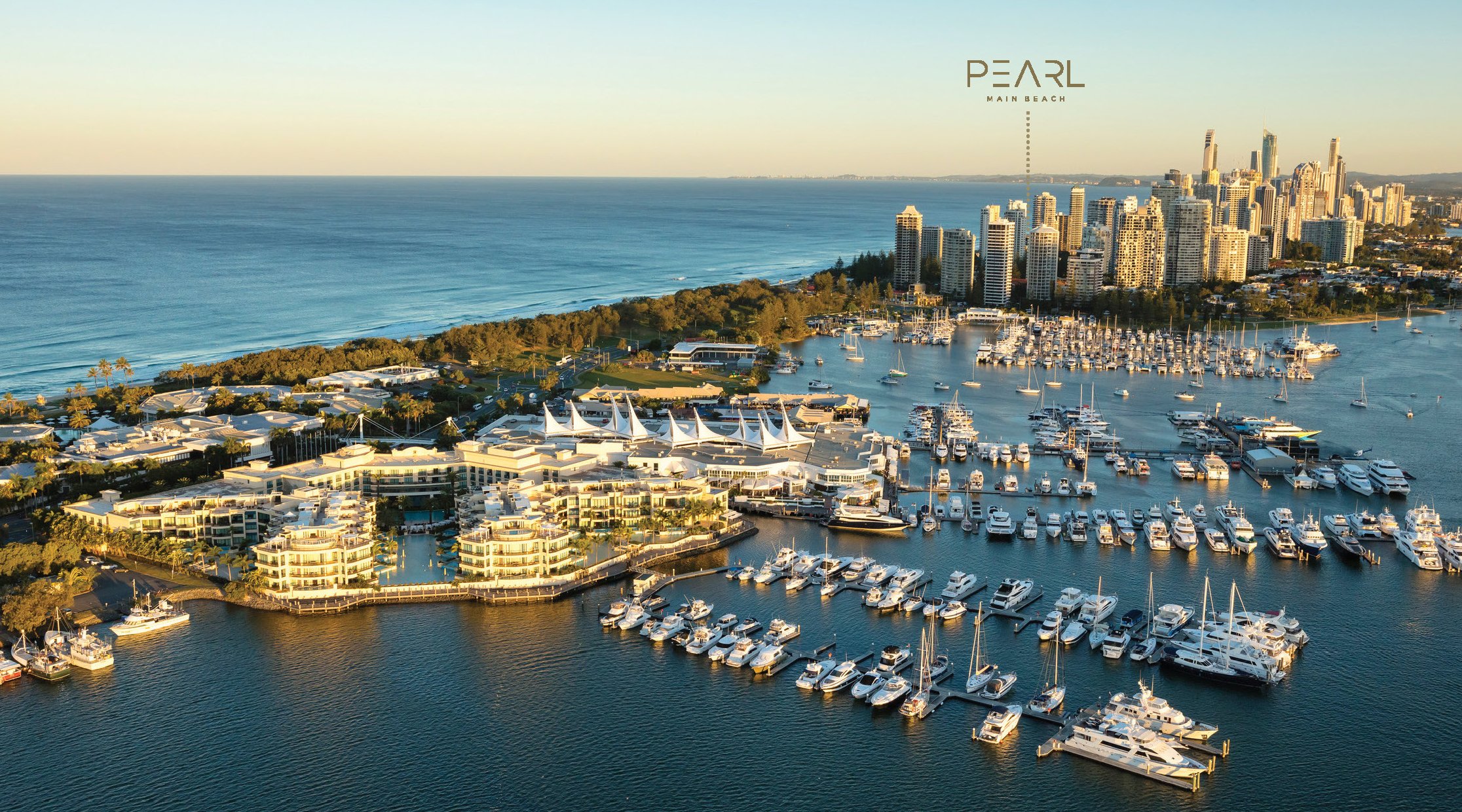
Location that cannot be replicated. 220 metres from the patrolled sands of Broadbeach. A 400-metre walk to the Oracle Boulevard dining precinct. Minutes from The Star Gold Coast. The address at 6–8 George Avenue is not an approximation of beachside living it is the article itself. Comparable sites on this stretch of the Gold Coast are not coming back to market.
Finishes that set a new benchmark. Top-of-range Miele cooking appliances. Integrated Fisher & Paykel French double-door refrigerator. A separate laundry with Fisher & Paykel dryer. An integrated walk-in butler's pantry with Vintec wine fridge. Freestanding bathtubs, sculpted vanities and bespoke joinery. Floor-to-ceiling double-glazed windows designed to capture ocean breezes and panoramic views. This is not the standard builder specification it is a full premium fitout designed for the buyer who expects the best.
Club Sterling resort amenities for residents only. A 22m × 4m resort-style pool and spa, cabanas, outdoor shower and alfresco BBQ area. Separate sauna and steam rooms. Gymnasium and Pilates studio with reformer benches. A fully equipped business suite with boardroom, and private outdoor terrace. Every amenity. Exclusively for 89 residences.
Raptis the developer credential that matters off-the-plan. When you buy off-the-plan, you are buying a promise as much as a product. Raptis brings over 45 years of Gold Coast development experience and a portfolio of more than 40 completed residential and mixed-use projects including Chevron Renaissance, The Phoenician and Southport Central that demonstrates consistent delivery. In a market where developer credibility has never mattered more, Raptis represents the top of the field.
Construction is advanced. Risk is reduced. With more than 65% of apartments already sold and construction well progressed, The Sterling is substantially de-risked compared with projects still in early planning or tender stages. For buyers weighing off-the-plan risk, proximity to delivery is a meaningful differentiator. Move in late June 2026.
The Case for Acting Decisively
The combination of confirmed legislative change and genuine product scarcity is rarely this clear.
The Budget changes are not proposals they are confirmed policy, effective from 1 July 2027, with the critical new-build exemption explicitly preserved. For an investor acquiring a qualifying off-the-plan apartment today, the tax framework is locked in: full negative gearing, choice of CGT treatment, and a depreciation schedule that established property cannot match.
For owner-occupiers, the tax question is largely secondary. What matters is the quality of the product, the irreplaceability of the location, and the long-term appreciation of well-positioned boutique coastal property all of which The Sterling delivers in full. For buyers who may one day lease the property, or transition between owner-occupation and investment, the asset serves both purposes with equal elegance.
Remaining stock is limited. The location is genuinely irreplaceable. The tax position for qualifying new construction has been definitively preserved by the 2026 Budget and the relative attractiveness of new builds versus established property has been permanently elevated.
The window that sophisticated investors have been watching is now defined. It is open. And it will not be open indefinitely.
Visit sterlingbroadbeach.com to register your interest and request a full investment briefing.
Important notice: This article is for general informational purposes only and does not constitute financial, legal or tax advice. The negative gearing and CGT changes described reflect the 2026–27 Federal Budget as announced on 12 May 2026 and are subject to the passage of enabling legislation. The new-build exemption status of The Sterling Broadbeach should be verified with a qualified tax adviser prior to any investment decision. Always seek independent financial and tax advice before purchasing property.